
Key Takeaways
- GFCI outlets save lives. They detect tiny imbalances in current and shut off power in milliseconds — fast enough to prevent serious shock.
- The National Electrical Code requires GFCI protection in bathrooms, kitchens, garages, basements, laundry rooms, outdoors, and anywhere within six feet of a water source.
- Older Fort Wayne homes often have gaps. If your home was built before the mid-1980s and hasn't had electrical updates, you likely don't have full GFCI coverage where today's code requires it.
- GFCIs wear out. Test yours monthly, and plan to replace any that are 10–15 years old — even if they still seem to work.
- A GFCI that won't reset is telling you something. It's either detecting a real fault, has failed internally, or has lost power. Don't ignore it.
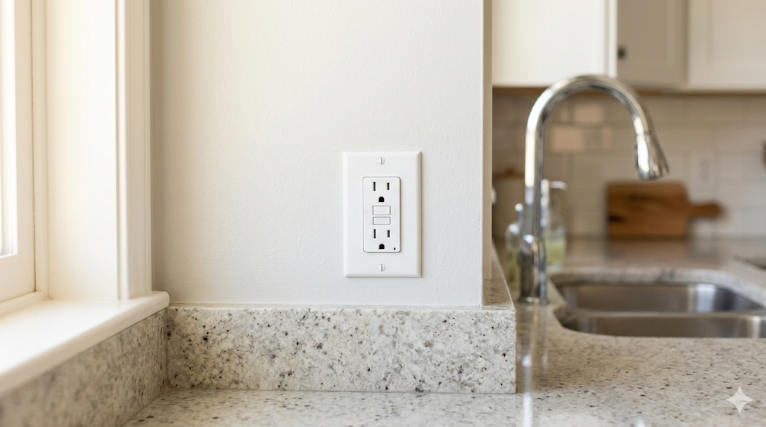
If you've ever pressed a small "TEST" or "RESET" button on an outlet near your kitchen sink or in your bathroom, you've used a GFCI. They're the outlets with the two little buttons in the middle, often found near water, outdoors, or in older parts of the house where someone has updated the electrical. The question most Fort Wayne homeowners ask isn't what a GFCI is — it's whether their home has enough of them, and whether the ones they have are still working.
Here's the short answer: yes, your home almost certainly needs GFCI outlets in more places than you think — and if your home is older than 1985, there's a good chance some of those required spots are still using standard outlets.
What Does a GFCI Outlet Actually Do?
GFCI stands for Ground Fault Circuit Interrupter. The outlet constantly monitors the current flowing out through the hot wire and back through the neutral wire. Those two should be equal. If even a tiny amount of current — as little as 4 to 6 milliamps — leaks out somewhere else (like through your body to a wet floor), the GFCI detects the imbalance and cuts power in about 1/40th of a second.
That speed is why GFCIs prevent fatal shocks. Standard outlets can't do this. A regular breaker only trips when current draw exceeds the breaker rating — usually 15 or 20 amps, which is far more than enough to kill you.
Where Are GFCI Outlets Required in Fort Wayne Homes?
The National Electrical Code (NEC) — which Indiana follows — requires GFCI protection in any location where water, dampness, or grounding paths are likely. Fort Wayne homes built or remodeled in recent years should already have full coverage, but older homes throughout neighborhoods like Canterbury Greens and out toward Roanoke often have gaps where the code has tightened over time but the wiring hasn't been updated.
Here's where current code requires GFCI protection:
|
Location |
GFCI Required? |
Why It Matters |
|
Bathrooms (all outlets) |
Yes |
Water and electricity in close proximity |
|
Kitchen counters (all outlets serving counters) |
Yes |
Sinks, wet hands, conductive appliances |
|
Within 6 feet of any sink |
Yes |
Includes wet bars, laundry sinks, utility sinks |
|
Garages (all outlets) |
Yes |
Damp concrete, wet vehicles, conductive tools |
|
Unfinished basements |
Yes |
Concrete floor, moisture, sump pumps |
|
Outdoors (any outlet) |
Yes |
Rain, snow, hose use, landscape equipment |
|
Laundry areas |
Yes |
Water lines, washing machines, damp floors |
|
Crawl spaces |
Yes |
Damp earth, plumbing |
|
Pools, spas, hot tubs (within 20 ft) |
Yes |
Highest shock risk in any home |
|
Dishwasher and sink disposal outlets |
Yes |
Water lines, conductive appliance casings |
If any of those spots in your home has a standard outlet instead of a GFCI, that's a code gap worth correcting. We see it routinely during electrical safety inspections.
How GFCIs Protect You From Shock
A standard outlet doesn't know whether the current it's delivering is going through your toaster or through your body. It just delivers power until the breaker trips — and as we mentioned, breakers trip on overload, not on current leak.
A GFCI knows the difference. The instant current starts flowing somewhere it shouldn't, the outlet cuts power. That's why the kitchen, the bathroom, and any outdoor outlet absolutely must have GFCI protection. A 6-milliamp leak through your body during a shave or while pulling weeds in the yard is the kind of moment that turns a routine task into a trip to the ER — and a properly working GFCI outlet prevents it.
How Often Should I Test and Replace My GFCI Outlets?
Test monthly. Press the "TEST" button — power should cut to anything plugged into that outlet. Press "RESET" to restore. If pressing "TEST" doesn't kill the power, the GFCI has failed and needs replacement immediately, even if it still resets normally.
Replace every 10–15 years as a rule of thumb. The internal sensing electronics wear down, and a worn GFCI loses its ability to detect ground faults reliably. If you can't remember the last time your GFCIs were replaced — and your house is more than 15 years old — assume they're due.
What's the Difference Between GFCI, AFCI, and Dual-Function Outlets?
You may have also heard of AFCI outlets, especially if your home has had recent electrical work. These two devices protect against different threats, and modern code increasingly requires both. Here's the quick breakdown:
|
Feature |
GFCI |
AFCI |
Dual-Function |
|
Protects against shock from ground fault |
✓ |
— |
✓ |
|
Protects against arc faults that can cause fires |
— |
✓ |
✓ |
|
Required near water |
✓ |
— |
✓ |
|
Required in bedrooms (newer code) |
— |
✓ |
✓ |
|
Required in living areas (newer code) |
— |
✓ |
✓ |
Dual-function outlets handle both — and they're increasingly the default in new construction and major remodels. If you're updating wiring in your home, ask whether dual-function makes sense for the rooms you're touching.
Why Does My GFCI Outlet Keep Tripping?
A GFCI that trips repeatedly is doing its job — it's detecting a real ground fault somewhere. The most common causes are a faulty appliance plugged into the protected circuit, moisture in an outdoor or bathroom outlet, deteriorated wiring insulation, or the GFCI itself reaching end of life.
Try unplugging everything on the circuit and resetting. If it stays reset, plug devices back in one at a time — the device that trips it is your culprit. If it trips with nothing plugged in, the issue is in the wiring or the GFCI itself, and that needs an electrician's diagnostic.
Can I Install a GFCI Outlet Myself?
It's tempting — GFCIs look like a straightforward swap. But there are real reasons most Fort Wayne homeowners shouldn't tackle this one. Wiring a GFCI requires correctly identifying line versus load terminals, confirming proper grounding, and testing the device under live conditions. Get any of those wrong and the outlet either won't protect you, will trip constantly, or will protect downstream outlets in unexpected ways.
There's also a code question. If your home doesn't have a grounded circuit, swapping in a GFCI without proper labeling and testing can leave you thinking you have protection you don't. DIY electrical work on safety devices is one of the highest-risk shortcuts homeowners take — and it's the one we'd most strongly recommend leaving to a licensed electrician.
When to Call a Licensed Electrician
If your Fort Wayne home is missing GFCI protection where code requires it, or if your existing GFCIs trip repeatedly, won't reset, or have never been tested — those are all good reasons to schedule an evaluation. So is a kitchen, bathroom, or basement remodel where electrical updates make sense to bundle in.
Mister Sparky of Fort Wayne handles GFCI installation, replacement, and full home safety inspections — and every job is backed by our UWIN Guarantee, a 100% satisfaction promise you won't find at every electrician.
We're also America's On-Time Electrician®. If we miss the appointment window we set with you, the repair is free: We're On Time, You'll See, Or The Repair Is Free!™
Call Mister Sparky of Fort Wayne at 260-868-4195 for upfront pricing on GFCI installation and inspection — no surprises. Serving Fort Wayne and surrounding communities including Roanoke and neighborhoods like Canterbury Greens — we're here when you need us.